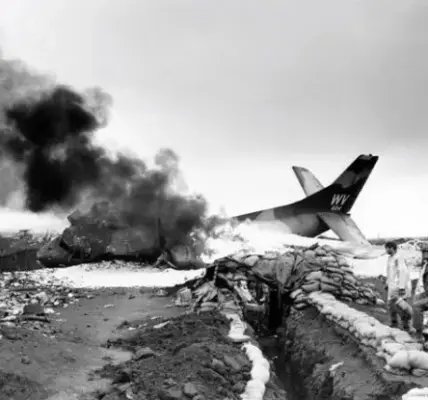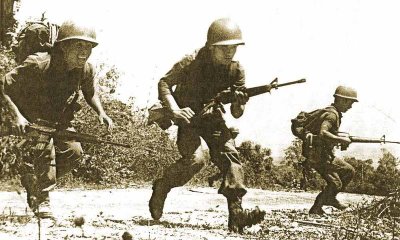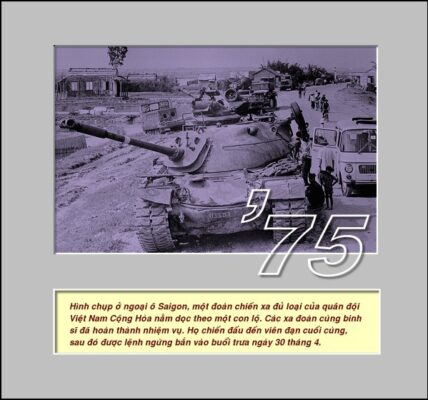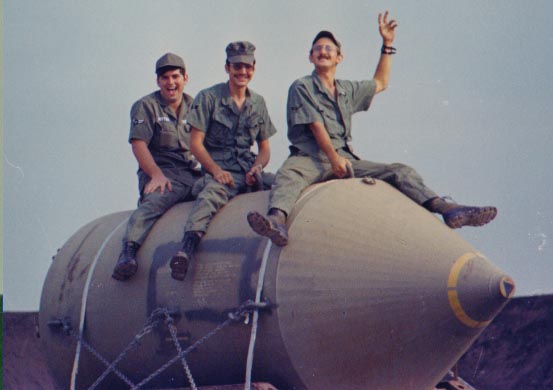


Trong Trận Long Khánh (Tháng 4 năm 1975), Không Quân Việt Nam Cộng Hòa có thả một quả bom đặc biệt, tiêu diệt cả Sư đoàn (?) quân CSBV, chặn đứng được cuộc tiến quân của chúng. Cho đến nay hảy còn nhiều câu hỏi quanh quả bom này và nhiều câu trả lời chưa được chính xác.
– Tác giả Chính Đạo (Tiến sĩ Sử học), trong tâp sách 55 Ngày đêm, Cuộc xụp đổ của VNCH ghi rằng VNCH đã sử dụng cả CBU lẫn ‘Daisy Cutter’ (nghĩa là 2 loại bom..khác nhau !) tại Mặt trận Long Khánh.
– Tác giả Trọng Đạt trong bài ‘Trận Xuân lộc Chiến thắng cuối cùng’ (Nguyệt San Việt Nam Online) có ghi khá nhiều chi tiết về các quả bom này kể cả tên (viêt tắt) của các phi công đã thả (xin xem phần dưới) các quả bom đặc biệt này..
– Viện Khoa Học Quân sự của CSVN thì ghi lại (theo tài liệu của Dawson) là KQ VNCH đã thả 1 quả bom CBU-55 xuống Ngã ba Dầu Giây Long Khánh vào ngày 21 tháng 4 năm 1975.
– Từ CBU..
Một trong những sáng kiến về Bom mà các kỹ sư võ khí HK đưa ra áp dụng tại VN là CBU hay Cluster Bomb Unit. Thật ra CBU chỉ là một áp dụng của việc nghiên cứu về loại vỏ khí có tên là Rổ bánh mì Molotov (Molotov bread basket) dùng năm 1937 trong Trận Nội chiến Tây Ban Nhạ Rổ bánh mì, đơn giản, chỉ là một thùng lớn chứa nhiều quả bom nhỏ để khi phi cơ thả xuống, thùng mở ra và rải các quả bom nhỏ trên một diện tích rộng lớn. Như thế Cluster Bomb hày Bom chùm chỉ có mục đích là mở rộng vùng sát thương của Bom khi thả xuống mục tiêụ.
– Loại CBU thứ tư là là loại Bom chùm gây cháy (Cluster bomb incendiary device). Loại bom này cũng có tên là Fuel Air Explosives CBU-55 là bom thuộc loại này, chứa nhiên liệu propane : CBU-55 nặng 750 pound (khoảng 340 kg) gồm 3 ngăn: một ngăn chứa propane, một ngăn chứa hỗn hợp khí khác và một ngăn chứa ngòi nổ. CBU-55 dài khoảng 2.3 m, đường kính 0.36 cm. Có 2 loại CBU-55 : Loại thứ nhất CBU-55/B chứa 3 bom BLU-73A/B đặt chung trong Hệ thống chứa SUU-49/B và loại thứ nhì là CBU-55 A/B chứa 3 BLU-73A/B trong thùng SU-49 A/B. Sự khác biệt là SUU-49B chỉ có thể thã bằng trực thăng hay phi cơ bay chậm, trong khi đó SUU-49A/B có thêm vi đuôi xếp lại nên có thể thả bằng các phi cơ bay nhanh như A-37, OV-10.. Các bom BLU nhỏ nặng khoảng 45 kg chứa ethylen oxyde lỏng. Khi nổ bom sẽ làm văng các giọt ethylen, tạo thành một đám mây nhiên liệu đường kính từ 17-25 m ở độ cao 2-3m. Đám mây này được kích hỏa bằng một ngòi nổ.. tạo thành một quầng lửa gây ngạt do thiếu oxy cho các sinh vật trong vùng..
Trong bài :’Kỷ niệm nhỏ với Đồng đội Chiến trường xưa’ trên Nguyệt San Việt Nam On-line, Tác gỉa NgyThanh ghi lại như sau : ‘ Khi chiến xa T-54 của Cộng sản từ Tỉnh lộ 8B ở thôn Cam Võ trên bờ Bắc tràn qua sông Miếu Giang, Bộ TTM QL VNCH bí mật cho phép sử dụng lần đầu tiên trên chiến trường VN loại bom CBU-55. Trưa 1 tháng 5 năm 1972, sau khi ném ‘trái bom nguyên tử bỏ túi’ vào đoàn xe tăng đang vượt cầu Đông Hà và làm cả đoàn xe chết khựng ngay trền cầu, Thiếu úy phi công Nguyễn Hàn mang chiếc A-37 về lại Phi đoàn 528 ở Đà Nẵng bình an.. (Thiếu Úy Nguyễn Hàn sau đó đã hy sinh trong một phi vụ yểm trợ cho TĐ 8 TQLC vào đầu tháng 10-1972 tại Chợ Sài (Quảng Trị)
Không quân, trên nguyên tắc, sẽ là quân chủng đảm nhận việc thả bom, nhưng ngay lúc này KQ HK không có loại phi cơ phóng pháo nào để thả được quả bom cỡ này : Bom không thể đưa vào khoang bụng của B-52, còn các phi cơ loại phóng pháo- chiến đấu như F-100, F-105.. lại không chở nổi loại bom quá nặng này, và biện pháp sau cùng là dùng các trực thăng hạng nặng hay Phi cơ vận tải để thả chúng..Có thể dùng trực thăng, nhưng với sức nặng của quả bom thì chỉ một vài loại trực thăng có đủ khả năng để chở nổi chúng : Trực thăng cần cẩu khổng lồ của US Army loại CH-54 Skycrane có thể đeo được 1 quả, nhưng bay quá chậm và mỗi phi vụ chỉ thả đưỡc 1 quả nên chi phí để thả quả bom tăng lên quá cao.
Tháng 10 năm 1968, những quả bom đầu tiên được thả thử tại Vùng 1 CT dùng Hệ thống Radar MSQ-77, hướng dẫn mục tiêu, đặt dưới đất tại PleiKu và Huế. Từ tháng 12-1968, bom được thả thử theo sự hướng dẫn của các Hệ thống radar thuộc TQLC HK, và từ mùa Xuân 1969, bom 10,000 lb đã được thả thường xuyên với tên gọi là Hệ thống võ khí M121
Như thế : Daisy Cutter là tên , đầu tiên, đặt cho Hệ thống võ khí M-121 này
Đến 1970, loại bom 10,000 lb còn lại từ Thập niên 50 đã được sử dụng hết. Trung tâm Võ khí HK đã chế tạo loại bom mới, khác hơn, dùng nhiên liệu lõng, pha trộn với thuốc nổ TNT, đặt trong những ngăn khác nhau (do đó có thể xem là một loại CBU).
Khi sử dụng để đánh nơi tập trung quân cũa CQ, BLU-82 được thả, lúc rơi xuống cao độ 30 m, nhiên liệu rãi tỏa thành đường dài đến 300m, và đám mây nhiên liệu này được kích nổ, khi cháy nổ sẽ hút hết dưỡng khí trong một vùng, gây ngạt thở và tạo ra một chấn động theo sau..


– Tác giả Robert Mikesh trong ‘Flying Dragons : The South Vietnamese Air Force’ ghi lại (trang 141) : ‘ Việt Nam được cung cấp tất cả 17 quả Daisy Cutter, .đả thả 15 quả, chỉ còn lại 2 quả..’

Quà tặng cho Việt Cộng – Trái CBU không ngòi nổ
The BLU-82B/C-130 weapon system, known under programme “Commando Vault” and nicknamed “daisy cutter

A daisy cutter is a type of Fuse designed to detonate a bomb at or above ground level. The fuse itself is a long probe affixed to the weapon’s nose, which detonates the bomb if it touches the ground or any solid object….
” in Vietnam
The Vietnam War, also known as the Second Indochina Wars, the Vietnam Conflict, or often in Vietnam the American War occurred in Vietnam, Laos and Cambodia from 1959 to April 30, 1975….
and in Afghanistan
The War in Afghanistan, which began on October 7, 2001 as the U.S. military operation Operation Enduring Freedom, was launched by the United States with the United Kingdom in response to the September 11, 2001 attacks….
, is a 15,000 pound (6,800kg) conventional bomb
A bomb is any of a range of explosive devices that typically rely on the exothermic chemical reaction of an explosive material to produce an extremely sudden and violent release of energy….
, delivered from an MC-130 transport aircraft. 225 were constructed.
Overview
Originally designed to create an instant clearing in the jungles of Vietnam, it was test-dropped there from a CH-54 Tarhe
The CH-54 Tarhe is a twin-engine heavy-lift helicopter designed by Sikorsky Aircraft for the United States Army. It is named after Tarhe , an eighteenth-century chief of the Wyandot Native Americans in the United States tribe….
“Flying crane” helicopter. Later it has been used in Afghanistan as an anti-personnel weapon and as an intimidation weapon because of its very large lethal radius (variously reported as 100 to 300 meters/300 to 900 feet) combined with a visible flash and audible sound at long distances. It was the largest conventional bomb for several decades. That title is now held by the Russian-made Father of All Bombs
Aviation Thermobaric Bomb of Increased Power , nicknamed “Father of All Bombs” , is a Russian-made bomber thermobaric weapon that is reportedly four times more powerful than the Military of the United States GBU-43/B Massive Ordnance Air Blast bomb ….
, which contains 7.8 tons of high explosives, although both these weapons were outstripped in weight and size by the T12 Cloud Maker
The T-12 demolition bomb was a weapon produced by the United States designed to create an Earth_quake_bomb. It achieved this by having an extremely thick nose section, which was designed to penetrate deeply into the earth….
penetration or earthquake bomb developed from the British Grand Slam bomb
The Grand Slam was a 22,000 Pound earth quake bomb used by RAF Bomber Command against strategic targets during the World War II.It was a scaled up version of the Tallboy bomb and closer to the original size that the bomb inventor Barnes Wallis had envisaged when he first developed his earthquake bomb idea….
of World War II
World War II, or the Second World War , was a global military conflict which involved a Participants in World War II, including all of the great powers, organised into two opposing military alliances: the Allies of World War II and the Axis powers….
. The T12 weighed 43,600 lb, almost twenty metric tons.
The BLU-82 uses conventional explosive ammonium nitrate
The chemical compound ammonium nitrate, the nitrate of ammonia with the chemical formula NitrogenHydrogen4NitrogenOxygen3, is a white powder at room temperature and standard pressure….
and aluminium
Aluminium or aluminum is a silvery white and ductile member of the boron group of chemical elements. It has the symbol Al; its atomic number is 13….
, incorporating both agent and oxidizer. In contrast, fuel-air explosives (FAE) consist only of an agent and a dispersing mechanism, and take their oxidizers from the oxygen in the air. FAEs generally run between 225 and 900 kg (500 and 2,000 pounds); making an FAE the size of a daisy cutter would be difficult because the correct uniform mixture of agent with ambient air would be difficult to maintain if the agent were so widely dispersed. Thus, the conventional explosive of a daisy cutter is more reliable than that of an FAE, particularly if there is significant wind or thermal gradient.
This system depends upon the accurate positioning of the aircraft by either a fixed ground radar
Radar is a system that uses electromagnetic radiation waves to identify the range, altitude, direction, or speed of both moving and fixed objects such as aircraft, ships, motor vehicles, weather formations, and terrain….
or on-board navigation equipment. The ground radar controller, or aircrew navigator as applicable, is responsible for positioning the aircraft prior to final countdown and release. Primary aircrew considerations include accurate ballistic and wind computations provided by the navigator, and precision instrument flying with strict adherence to controller instructions. The minimum altitude for release due to blast effects of the weapon is 6,000 feet (1,800 m) above ground level (AGL). The warhead contains 12,600 pounds (5,700 kg) of low-cost GSX slurry
A slurry is, in general, a thick suspension of solids in a liquid and may be:* A mixture of water and cement to form concrete* A mixture of water, thickening agent#weapon use, and oxidizers used as an water gel…
(ammonium nitrate
The chemical compound ammonium nitrate, the nitrate of ammonia with the chemical formula NitrogenHydrogen4NitrogenOxygen3, is a white powder at room temperature and standard pressure….
, aluminium
Aluminium or aluminum is a silvery white and ductile member of the boron group of chemical elements. It has the symbol Al; its atomic number is 13….
powder and polystyrene
Polystyrene , sometimes abbreviated PS, is an Aromaticity polymer made from the aromatic monomer styrene, a liquid hydrocarbon that is commercially manufactured from petroleum by the chemical industry….
) and is detonated just above ground level by a 38-inch (965 mm) fuse extender, optimized for destruction at ground level without digging a crater
In the broadest sense, the term impact crater can be applied to any depression, natural or manmade, resulting from the high velocity impact of a projectile with larger body….
. The weapon produces an overpressure of 1,000 pounds per square inch (psi) (7 MPa) near ground zero, tapering off as distance increases.
The BLU-82 was originally designed to clear helicopter landing zones and artillery
Artillery is a military Combat Arms which employs any apparatus, machine, an assortment of tools or instruments, a system or systems used as weapons for the discharge of large projectiles in combat as a major contribution of fire power within the overall military capability of an armed force….
emplacements in Vietnam. South Vietnamese VNAF aircraft dropped BLU-82 bombs on NVA positions in desperation to support ARVN troops in the Battle of Xuan Loc
The Battle of Xuan Loc also known as “the last stand at Xuan Loc”, was the last major battle of the Vietnam War that took place in Xuan Loc, Dong Nai Province….
in the last days of the Vietnam War.
Eleven BLU-82Bs were palletized and dropped in five night missions during the 1991 Gulf War
“Persian Gulf War” and “First Gulf War” redirect here. For other uses, see Persian Gulf War .The Persian Gulf War was a United Nations-authorized military conflict between Iraq and a Coalition of Gulf War from 34 nations commissioned with expelling Iraqi forces from Kuwait after Iraq’s Invasion of Kuwait of Kuwait in August 1990….
, all from Special Operations
Special operations are military operations that are considered “special” .Examples of special operations include such operations such as reconnaissance/military intelligence, unconventional warfare, and counter-terrorism actions….
MC-130 Combat Talon
The Lockheed MC-130 is the basic designation for a family of special missions aircraft operated by the Air Force Special Operations Command of the United States Air Force….
s. The initial drop tested the ability of the bomb to clear or breach mine fields; however, no reliable assessments of mine clearing effectiveness are publicly available. Later, bombs were dropped as much for their psychological effect as for their anti-personnel effects.
The US Air Force
The United States Air Force is the aerial warfare branch of the Military of the United States and one of the uniformed services of the United States….
dropped several BLU-82s during the campaign to destroy the Taliban and al-Qaeda
Al-Qaeda, alternatively spelled al-Qaida and sometimes al-Qa’ida, is an international Sunni Islam Islamist Extremism movement founded sometime between August 1988 and late 1989/early 1990….
terrorist networks in Afghanistan to attack and demoralize personnel and to destroy underground and cave complexes. On 15 July 2008, Airmen from the Duke Field
Duke Field , also known as Eglin AFB Auxiliary Field #3, is a military airport located three miles south of the central business district of Crestview, Florida, in Okaloosa County, Florida, Florida, United States….
711th Special Operations Squadron, 919th Special Operations Wing
The 919th Special Operations Wing is an Air Force Reserve wing of the United States Air Force based at Eglin AFB Auxiliary Field #3 / Duke Field, Florida….
dropped the last operational BLU-82 at the Utah Test and Training Range.