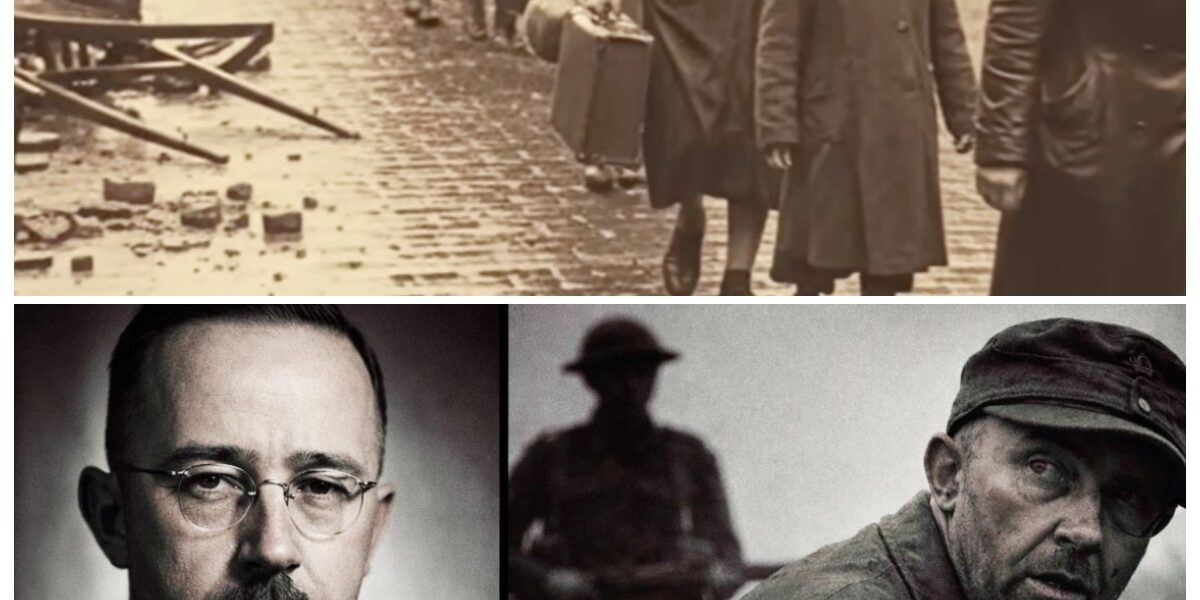
SCHOCKIEREND: Der meistgesuchte Mann der Welt – Hinrich Himmler – auf der Flucht im Mai 1945! hyn


May 1945, the war in Europe is over and the roads of northern Germany are choked with the wreckage of a collapsed civilization.
Millions of displaced people are walking in every direction at once.
Refugees carrying everything they own in pillowcases and broken suitcases.
Former soldiers in torn uniforms trying to melt into the civilian chaos.
and scattered among them, hiding in plain sight, some of the most wanted men in human history.
The British Army’s job in those first strange weeks of peace was not only to restore order to the rubble of the Third Reich.
It was to find these men, to pull them from the crowd, tear away the disguises, and drag them into the light of justice.
Most of the senior Nazi leadership had already been rounded up, cornered, or had taken their own lives in the last hours of the Berlin bunker.
But one man remained at large.
A man whose name had been synonymous with absolute terror for over a decade.
Hinrich Himmler.
Reichfurer of the SS commander of the Gestapo, architect of the Holocaust, the man who had put an industrial machinery of death into motion that consumed 6 million Jewish lives and millions more.
He was out there somewhere in the gray May reign of northern Germany.
and he believed.
He genuinely believed that he could talk his way out of whatever came next.
This is the story of how a handful of British soldiers ended that delusion.
And what happened in the hours that followed is one of the most extraordinary final acts in the entire history of the Second World War.
The man behind the horror.
To understand why the capture of Heinrich Himmler mattered so much, you have to understand who he actually was.
Because the picture history gives us of the great Nazi villains is often dominated by the raging ortor, the screaming ideologue, the man who fills a stadium and works a crowd into frenzy.
Himmler was none of those things.
He was born in Munich on the 7th of October 1900 into a middleclass Catholic family.
His father was a school teacher who had once tutored a member of the Bavarian royal family, which gave the Himmlers a certain modest social standing.
Young Hinrich was studious, bookish, and socially awkward.
He kept a diary from the age of 10.
He struggled with his health.
Stomach problems plagued him his entire life.
He was not athletic.
Other boys at his school remembered him as someone you noticed mainly for his absence from the playing field.
He wanted desperately to be a soldier.
He enrolled in a reserve battalion during the First World War, but never saw combat.
The war ended before he could get to the front, and he graduated into a Germany that was shattered, humiliated, and seething with resentment.
He studied agriculture at the Technical University of Munich, got his degree, and then tumbled into the orbit of the far-right nationalist politics that were swirling through the wreckage of the VHimar Republic.
By 1923, he had joined the Nazi party.
By 1925, he was in the SS, the Schutz stafle, or protection squadron, which at that point was nothing more than a small bodyguard unit for Adolf Hitler with fewer than 300 men.
What happened next is one of the most chilling administrative stories in history.
Himmler was given command of the SS in 1929.
He was 28 years old.
Over the next 16 years, through a combination of relentless ambition, bureaucratic genius, and a capacity for calculated ruthlessness that made even other Nazis uneasy, he transformed that 290man bodyguard into the most powerful organization in the Third Reich.
By the height of the war, the SS was a state within the state, a vast empire with its own military forces, its own intelligence services, its own economic enterprises, its own racial programs, and its own extermination infrastructure.
Over a million people wore the uniform.
He controlled the Gestapo, the criminal police, and the concentration camp system.
When Hitler wanted someone to oversee the implementation of the final solution, the systematic murder of every Jewish person in Europe, it was Himmler he turned to.
And he did it not by shouting, not by inspiring rallies.
He did it through organization, paperwork, logistics, and a bureaucratic thoroughess that never seemed to waver.
Even when the subject of that organization was mass murder, he visited the camps.
He watched executions.
In 1941, he stood at the edge of an execution pit in Minsk and watched SSmen shoot Jewish men, women, and children.
He came away shaken by the psychological toll it was taking on his killers.
and his response was to order the development of more efficient, more impersonal methods of mass death, the gas chambers.
He was not a man who enjoyed the gore.
He was a man who wanted the result delivered on time and under budget with the minimum disruption to the operational schedule.
The Holocaust unfolded under his administrative supervision.
By the time the war ended, Himmler’s organization had been directly responsible for the deaths of an estimated 5 and a half to 6 million Jewish people along with hundreds of thousands of Roma, Soviet prisoners of war, political opponents, homosexuals, and disabled people.
The numbers are so vast they stop feeling like numbers at all.
Behind each one was a human being with a name, a family, a home, a future that was stolen.
That is the man who in May 1945 was walking along a muddy road in a stolen uniform with a fake name in his pocket, hoping nobody would look too closely.
The gambler’s last bet.
By early 1945, even a man as wedded to delusion as Himmler could see that Germany was finished.
The Red Army was closing on Berlin from the east.
The Western Allies had crossed the Rine and were pouring into the heart of the Reich.
Cities were rubble and fire.
The economic infrastructure was collapsing.
The war was lost.
The question was no longer if, it was only what happened next.
and Himmler in his extraordinary disconnection from reality believed he had a card to play.
He had spent months in private conversations with advisers particularly his intelligence chief Walter Shelonberg and his personal Msurre Felix Kirsten developing a private theory about the post-war world.
The Western Allies, he reasoned, would need a strong Germany as a buffer against Soviet expansion.
They would need order.
They would need a police force.
And who better to provide that order than the man who had managed German security for over a decade.
Heinrich Himmler was an indispensable expert in maintaining control.
Surely Eisenhower would see that this was not cynical calculation.
This was genuine unmedicated delusion.
Himmler truly believed that his expertise in state terror would make him a useful partner to the men who had just spent six years fighting to destroy everything he represented.
In the spring of 1945, he made his move.
He arranged a secret meeting with Count Folk Bernadot, the Swedish diplomat and vice president of the Swedish Red Cross, who had been negotiating the release of Scandinavian concentration camp prisoners through the famous white buses operation.
On the night of the 23rd of April 1945, Himmler met Bernadot at the Swedish consulate in Lubec.
He presented himself as the provisional leader of Germany.
Hitler, he said, was dying and essentially irrelevant.
He proposed a separate peace.
Germany would surrender to the Western Allies on the entire Western Front, including the Netherlands, Denmark, and Norway, but would continue fighting the Soviet Union in the East.
It was a breathtaking proposal, and it contained one particularly telling fantasy embedded in its logic.
Himmler still imagined himself as a major player in whatever came next, someone who would be sitting at the table when the post-war order was drawn up.
Bernadot took the proposal to the Swedish Foreign Office, which passed it to the British and American governments.
The response was immediate and unambiguous.
Unconditional surrender to all Allied powers or nothing.
There would be no separate peace.
there would be no negotiated position for Heinrich Himmler.
And then the news leaked to the BBC.
Hitler heard the broadcast in the Fur bunker in Berlin.
He had called Himmler Deer Troya Heinrich, the loyal Heinrich for years.
The one follower who would never betray him.
Now in the final hours of his life, even that certainty was gone.
Hitler flew into a fury that eyewitnesses described as unlike anything they had ever seen.
He ordered Himmler’s arrest, he had Himmler’s SS representative in the bunker, Herman Fageline.
Dragged back from an attempt to escape and executed.
In an instant, Himmler had gone from the second most powerful man in the Third Reich to a wanted man.
He had no master and no future.
The Nazi state he had helped build and serve for 20 years had turned on him.
The allies wanted him for war crimes.
The crumbling Reich wanted him dead.
And on the 6th of May, Grand Admiral Carl Donuts, the man Hitler had named as his successor, sent Himmler a letter formally dismissing him from every post he held.
He had nothing left.
the vanishing act.
So began one of the most staggering exercises in wishful thinking.
The war produced.
Heinrich Himmler, one of the most photographed and recognizable men in Nazi Germany, attempted to disguise himself and disappear.
He started with the obvious.
The toothbrush mustache, that small clipped rectangle of hair that had become a signature of the Nazi elite, came off.
He put a black eye patch over his left eye.
His round wire rimmed glasses, another of his instantly recognizable features, were replaced by thick framed horn rimmed ones.
He stripped off his immaculate black SS uniform with its silver collar insignia and death’s head insignia and put on the rough shapeless gray green uniform of an ordinary vermock sergeant.
Then he needed papers.
He took the identity documents of a real man, a man named Hinrich Hitzinger who had been a sergeant in the Gahimeld politai, the secret field police.
The irony here is almost unbearable.
Hitinger was a real person who had been executed by the regime some months earlier, ordered shot for defeatism.
In other words, for expressing doubt about Germany’s ability to win the war.
The man whose death Himmler’s system had authorized now became Himmler’s disguise.
On the 10th of May 1945, with a group of about 14 disguised SS companions, including some of his most senior aids, Himmler left Flynnsburg in northern Germany and began moving south.
The group included some very prominent men.
Dr.
Carl Ghart, Himmler’s personal surgeon, Berlin Gestapo, Chief Otto Olandorf, agitant Verer Groman, and Himmler’s bodyguard and chauffeur, Yseph Kirmire.
They drove south for a while, then at some point abandoned the cars, and continued on foot, sleeping in barns and fields, eating whatever they could find, moving with the general southward drift of the thousands of other German soldiers and civilians, also attempting to get somewhere safer.
Himmler’s plan, vague as it was, seemed to involve reaching Bavaria, perhaps hiding in the mountains there, waiting out whatever political convulsions followed Germany’s defeat, and eventually somehow emerging to offer his services to whoever needed a man with his particular skills.
The fantasy never quite died.
Even now, shivering in a barn in the German countryside, he seems to have genuinely believed that at some point someone in authority would send for him.
The group eventually made it to the area near the mouth of the Austa River on the southern bank of the Elby.
At a place called Noi House, the larger party split up.
Himmler continued with just two aids, his tall militarybearing agitant Verer Growthman and SS Major Heines Mocker.
Three men walking, the most wanted man on earth and two minders trying to keep up appearances.
By the 21st of May, the three of them were approaching the small town of Bremer Verda in the flat agricultural country of Lower Saxony between Hamburg and Bremerhav.
To move south, they needed to cross the river Osta.
And to cross the OA, they needed to cross a bridge.
And on the bridge, as on every bridge and checkpoint across northern Germany in those weeks, were British soldiers.
The stamp that doomed him.
Here is where one of the great ironies of the entire war reveals itself.
Himmler was not caught because a soldier recognized his face.
He was not caught because someone tipped off the allies.
He was caught because of a rubber stamp, because of a bureaucratic detail in a forged identity document that the men who created his disguise didn’t know was a giveaway.
Sergeant Arthur Britain and Sergeant Ken Bae Brown of the 45th Field Security Section Intelligence Corps were on duty at the checkpoint near Bremer Vorta along with Staff Sergeant John Hog of the 1003 Field Security Reserve.
detachment.
These men were not ordinary foot soldiers with rifles.
They were intelligent specialists trained specifically to identify forgeries, recognize suspicious documents, and spot SS members trying to slip through the net.
The British military intelligence system had been extremely thorough in training its checkpoint personnel, particularly on one crucial point.
The Gahimfeld Pitai, the secret field police or GFP, had been designated a criminal organization by the Allied command.
Any German carrying documentation linking them to the GFP was subject to automatic arrest and interrogation.
No exceptions.
Himmler and his SS colleagues had forged documents presenting themselves as recently discharged NCOs of the Gahima Feld Pitai.
They thought this was a sensible cover.
The GFP was a large organization.
Its members wouldn’t be personally known and it would explain why they were in the area without an obvious unit affiliation.
What they didn’t know was that the GFP stamp on the documents was a red flag that guaranteed interrogation.
There was also an earlier encounter that set the trap.
Before Himmler and his two aids arrived at the bridge, another larger group from his original traveling party, 12 men, including Dr.
Ghart, had crossed the same checkpoint.
Sergeant Baze Brown had noticed the GFP stamp on their documents and grown suspicious.
He’d arranged for those 12 men to be detained and taken away for processing while giving them the impression they’d been cleared and were being sent with an escort to collect their sick comrades at a nearby farm.
That ruse bought time and created an alert.
Two or three more members of the suspicious GFP group might be in the area.
When Himmler, Growthman, and Mocker arrived at the bridge that evening of the 22nd of May, Britain noticed them immediately.
Two tall military-bearing men in long green overcoats walking ahead of a shorter, shabier figure in a mismatched collection of civilian and military clothing, wearing a blue raincoat and a black patch over one eye.
The two taller men kept glancing back at the shorter man as if checking he was keeping up.
That backwards glance, that instinctive reflexive difference to the man they were escorting, was itself suspicious? You don’t keep checking on your equal, you check on your superior.
Britain examined their documents.
The GFP stamp was right there plain as day and dated after the 1st of May 1945, which was itself a further red flag since the GFP had been effectively dissolved by that point.
All three were placed under arrest and taken to spend the night at the checkpoint.
They were given food and a place to sleep on the floor.
and no indication was given that they were in any particular trouble.
Britain was playing it carefully, not tipping his hand.
The next morning, the 23rd of May, Britain drove the three men in a truck to the number 031 Civilment Camp at Barnstead, south of Lunberg.
Hika stopped at Zean on the way to report the arrest to Captain Excel at 45 Field Security Section headquarters.
The three prisoners still had no idea what was coming.
Sergeant Hittzinger, as Himmler was still calling himself, had so far maintained his cover.
His face, with the eye patch and the unshaven stubble and the hollow cheeks of weeks on the road, hadn’t been recognized.
His papers, fatally flawed as they were, had served well enough at a surface glance.
The extraordinary bureaucratic trap was complete.
The SS had forged Himmler’s disguise using the stamp of an organization whose members were subject to automatic British arrest.
The man who had built a regime on meticulous bureaucracy had been undone by a piece of paper.
The mask falls.
At around 6:30 in the evening on the 23rd of May, Sergeant Hitittzinger and his two companions were booked into the 031 civil interrogation camp at Barnstead.
The camp was processing hundreds of prisoners and the three men were initially lost in the administrative flow, but almost immediately something drew attention.
Another officer in the camp, a man named Calfman, who had apparently encountered Himmler before the war, spotted an odd figure near the camp perimeter.
He watched the man slip behind a bush, remove an eye patch, and reappear wearing a pair of spectacles.
In that moment, putting on those glasses, the man’s face shifted into something unmistakable.
Calfman knew instantly who he was looking at.
At around 7 in the evening, Captain Thomas Sylvester, the commandant of the internment camp, was told that three prisoners were requesting to speak with him personally.
This was unusual enough on its own.
Ordinary prisoners didn’t request private audiences with camp commonants.
Sylvester agreed to see them.
Into his office walked three men.
The first was small, shabby, ill-looking, wearing a patch over his left eye.
Behind him came two tall, soldierly figures, Growthman and Macker, both immediately imposing in their bearing.
Sylvester later wrote in his account that he sensed something unusual immediately.
He had the two taller men removed to close custody and left alone with the small man.
What happened next has become one of the defining moments in the final chapter of the Second World War.
The small man standing in front of Captain Sylvester reached up and removed the black eye patch.
He placed on his face a pair of round wire rimmed glasses.
He straightened slightly.
He looked at the British officer across the desk and then he said very quietly, “I am Hinrich Himmler.
” He expected by multiple accounts that the announcement would produce a certain reaction.
Deference, urgency, the rapid telephoning of senior officers, treatment befitting a man of his former stature.
He had a letter for Field Marshall Montgomery.
He said he wanted to speak with Eisenhower.
What he got instead was Captain Sylvester looking at him and saying, “Oh, it’s you.
” Not a salute, not a scramble, not the recognition of a great man arriving in the room, just the quiet, flat acknowledgment of a prisoner who had been identified.
Sylvester immediately telephoned intelligence headquarters.
The message was short.
We have Himmler.
The order came back just as quickly.
Search him.
Strip him.
Ensure he has no poison on his person.
Sylvester confirmed Himmler’s identity by having him sign his name and comparing it against a specimen signature that was brought to the camp.
The match was exact.
Major Norman Rice, an intelligence staff officer, arrived to formally confirm the identification.
Two body searches followed, conducted with painstaking care.
His clothing examined item by item.
Every pocket turned out, seams checked, every orifice searched.
In the jacket, Sylvester found a small brass case the size of a rifle cartridge containing a glass vial.
He asked Himmler what it was.
Himmler said it was medicine for stomach cramps.
He also found an empty second brass case, which meant there was a second vial somewhere, and it hadn’t been found yet.
But the search, thorough as it was, failed to locate it.
At 9:45 in the evening, Colonel Michael Murphy, the chief intelligence officer at Second British Army headquarters in Lunberg, arrived personally to take charge of the prisoner.
Himmler refused to put on a British Army uniform for the transfer.
He was given a blanket to wrap around his shoulders instead and driven the 10 mi to British headquarters, a red brick villa at 31 A Yulinerstrasa in Lunberg wrapped in a gray blanket in the back of a British army jeep surrounded by armed guards.
During the drive, according to accounts of those present, Himmler knew which road they were on before the colonel did.
You are on the road to Lunberg, he told Murphy when the colonel was trying to orient himself in the dark.
Even now, even stripped of everything, the man retained that instinct for information and control.
He was still in some part of his mind trying to manage the situation.
He was not yet ready to believe that it was over.
The stripping of power at the villa in Lunberg.
The second medical examination began.
It was approaching 11:00 at night.
Captain CJ Wells of the Royal Army Medical Corps was assigned to conduct a thorough search of the prisoner, specifically to find any concealed poison capsule that the previous searches had missed.
Himmler stood in the room.
He had ranted during his time at the camp about being too important to deal with underlings.
He wanted generals.
He wanted Eisenhower.
He had outlined with what must have struck the British officers in the room as extraordinary disconnection from reality his vision for the post-war world, a partnership between the Western Allies and a reorganized Germany to confront the Soviet threat.
He still believed even here that his knowledge and experience made him valuable, that there was a deal to be made.
No one in the room was interested in the deal.
They wanted to make sure this prisoner didn’t kill himself before he could be put on trial at Nuremberg.
Dr.
Wells examined him methodically.
He worked through the body systematically under the arms, in the ears, through the hair, along the scalp.
Nothing.
Then he came to the mouth.
He told Himmler to open it and leaned toward the light.
As Wells brought the lamp closer and peered inside, he noticed something in the gap between Himmler’s left cheek and his lower teeth.
A small, dark object, something that didn’t belong there.
Wells moved to remove it.
He slipped his finger toward Himmler’s cheek, and Himmler bit down.
He clamped his jaw shut on the doctor’s fingers, wrenched his head violently to one side, and crushed the tiny glass vial between his back teeth.
The smell hit the room instantly.
A sharp, bitter almond odor that the men there knew from their training.
Proic acid, potassium cyanide.
Someone in the room shouted something that various accounts record differently, but the shock was universal.
Himmler crumpled toward the floor.
The men grabbed him.
They tried everything they could think of.
They held him upside down, hoping to force the poison out.
They poured water down his throat.
A needle and thread were used to try to pull the tongue aside and clear the airway.
More medical personnel were called.
Colonel Murphy reportedly shouted that they needed him for Nuremberg.
Potassium cyanide is merciless.
It prevents the body’s cells from using oxygen and shuts down the central nervous system with brutal speed.
Within 15 minutes, the thrashing stopped.
At 11:14 in the evening on the 23rd of May, 1945, Hinrich Himmler was declared dead.
He lay on the floor of the interrogation room in a British Army shirt and socks, a gray blanket pulled over his shoulders, his round glasses placed on his face to make identification easier.
The rice furer SS was dead, not at the end of a rope in front of the world at Nuremberg.
Not publicly judged, convicted, and executed with the full weight of Allied justice behind it.
He had escaped the courtroom at the last possible moment in the most cowardly way available to him by hiding a capsule of poison in his mouth and waiting for the right second to use it.
He had denied the victims of his crimes the only thing that might have given them some measure of justice, the spectacle of his public reckoning.
The British commanders were furious.
They had wanted him alive.
They had wanted the Nuremberg trials to have him in the dock.
The man who had commanded the concentration camps, who had signed the orders, who had visited the killing sites, who had overseen the entire machinery of the final solution.
Without him, that testimony was lost.
Those secrets went with him.
No grave, no glory.
In the immediate aftermath, the British made a deliberate decision about how to handle what came next.
They had a corpse and a dilemma.
Himmler had been one of the most powerful men in Europe.
His followers had worshiped him.
If they gave him any kind of marked resting place, it would become a pilgrimage site, a shrine where the neo-Nazis of the future could come to mourn their hero and draw inspiration from his memory.
That was unacceptable.
First, they released photographs.
The images taken in the hours after Himmler’s death were not flattering portraits of a fallen soldier.
They were stark, clinical, deliberate.
Himmler on the floor, wrapped in a blanket, his mouth slightly open, his expression frozen in the particular blankness of the newly dead.
The photos were given to the press immediately.
The message was explicit.
Look at this man.
Look at how he ended.
Not a hero’s death, not a soldier’s death, a hunted animals death.
In a room, on a floor, in a borrowed blanket.
The body lay in the villa for 2 days.
Medical and intelligence officers from the British, American, and Russian forces came to confirm the identification.
An autopsy was conducted on the 25th of May.
The body’s teeth configuration was examined and compared against dental records.
The brain was removed and preserved.
Part of the skeleton was retained.
Every possible effort was made to confirm beyond any doubt that this was genuinely Heinrich Himmler and that he was genuinely dead.
Then came the burial.
On the 26th of May 1945, four British soldiers were given a task that had to be carried out in complete secrecy.
Major Norman Whitaker commanded the party.
Command Sergeant Major Edwin Austin, who had, in a delicious biographical footnote, worked for his local council and sanitation before the war, supervised the detail.
Sergeants Ray Weston and Bill Ottery completed the group.
They loaded Himmler’s body wrapped in a camouflage net into the back of an army van.
One of the soldiers climbed in beside the body.
They followed a jeep driven by Austin and the commanding officer.
They drove out onto the Lunberg Heath, a vast rolling expanse of Morland and forest in lower Saxony, a place known before the war as a popular destination for city dwellers from Hamburgg and Bremen, now empty and silent.
3 weeks earlier, in roughly the same piece of land, the German army had formally surrendered to Field Marshal Montgomery.
Now the man who had commanded the SS was about to be put into the ground in an unmarked hole nearby.
They made sure no press vehicles were following them.
They checked behind them repeatedly.
When they reached a spot deep enough in the trees to guarantee privacy, they stopped.
Sergeant Otterie later recalled that digging was harder than expected.
The roots of the trees tangled below the surface and made the work slow.
They stopped occasionally to drink from the beer they had brought along.
When the hole was deep enough, not deep, just deep enough, they placed the body inside.
They filled in the earth.
They covered the disturbed ground with branches and leaves, doing their best to make it look like the undisturbed forest floor.
And then they drove away.
They were sworn to secrecy.
No map was made.
No coordinates were recorded.
No memorial of any kind was placed before they died.
Two of the burial party, Sergeants Weston and Ottery, took the editor of the magazine after the battle to the approximate location.
That editor has kept the secret.
The British government files on the matter remain classified.
To this day, nobody outside a very small circle knows exactly where Hinrich Himmiler’s body lies.
He is somewhere under the roots of trees in the Lunberg heath, unmarked, anonymous, slowly becoming part of the soil.
The man who had dreamed of SS castles and racial empires, who had envisioned monuments to himself and the organization he built, who had accumulated more real power than almost any individual in human history.
He ended up in a hole in the ground that nobody can find.
There is something in that which feels like justice, even if it isn’t the kind that was deserved.
What it means, Himmler’s end was different from the other senior Nazis who followed him out of the world in the years after 1945.
Herman Guring also committed suicide, but he did it in his cell at Nuremberg after the trial, after the verdict, after the world had heard the evidence against him.
He cheated the hangman, but he did not cheat the courtroom.
He sat through it.
He answered the questions.
He had to listen as the evidence of what he had participated in was laid out in systematic, documented, unambiguous detail.
Himmler skipped all of that.
He bit the capsule before the trial could begin, before he could be made to sit in a dock and look at photographs of the places his orders had built, before survivors could point at him across a courtroom.
It was, as General Patton reportedly remarked when he heard the news, an act of cowardice.
A soldier faces his fate.
But there is a certain grim irony in the manner of his unmasking that transcends the frustration of his escape from the courtroom.
Hinrich Himmler was the great bureaucrat of the Nazi state.
He believed in the power of proper documentation, correct stamps, organized files, meticulous recordkeeping.
He ran the Holocaust like an administrative project.
He signed the forms.
He kept the records.
He made sure everything was properly logged and processed.
And in the end, a rubber stamp on a piece of paper gave him away to a British sergeant trained to recognize exactly that stamp.
The intelligence that caught him didn’t come from a spy or a dramatic chase or a firefight.
It came from a British army training program that had taught its personnel to recognize a specific bureaucratic detail.
The Gahima politai stamp on a demobilization certificate as a trigger for automatic arrest.
Himmler’s own side had created the forged document that doomed him.
The machinery of the regime he had built and served for 16 years had in the end betrayed him as completely as he had betrayed Hitler.
He died believing he was indispensable.
He died believing that somewhere at some level the people holding him prisoner understood that he was too important, too knowledgeable, too useful to simply dispose of.
He died waiting for the call from Eisenhower that was never coming.
And then three days later, four British soldiers drove him into the woods and buried him under a tree where no one would ever put a wreath or a candle or a flag.
The 45th field security section, the 031 civil internment camp, the medical officer who finally spotted the capsule.
None of these men set out to make history.
They were doing their jobs, checking papers, processing prisoners, conducting medical exams, the same routine, the same check boxes, the same protocols that had been applied to hundreds of thousands of other German detainees.
The difference was that this time the man being processed was the second most powerful person the Third Reich had ever produced.
And not one of them offered him the salute he expected.
The story of Hinrich Himmler’s end doesn’t provide the clean, satisfying resolution that some stories do.
We don’t get the image of him standing in a dock, hearing his sentence pronounced, walking to the gallows with the weight of the world’s judgment upon him.
We were cheated of that in the end by his own act of desperate cowardice.
What we have instead is something smaller and in its way more truthful.
We have a frightened man with a black eye patch and a forged piece of paper shuffling across a bridge in northern Germany in the May rain, hoping that nobody would look too closely.
We have a British sergeant noticing a rubber stamp that shouldn’t be there.
We have a camp commandant unimpressed by a famous name.
We have a doctor’s finger reaching into a prisoner’s mouth.
We have soldiers driving through the woods at dawn, digging a hole that nobody would ever find.
The Third Reich ended not with a final dramatic confrontation, but with these small grinding moments of institutional competence quietly doing its job.
And somewhere under the Lunberg heath, with no stone to mark the spot and no grave for anyone to visit, is what remains of the man who once held the power of life and death over millions.
If you found this story as gripping as we did, please hit that like button and subscribe to WW2 for more in-depth history told exactly this way.
precise, immersive, and always reaching for the human story inside the historical record.
There’s plenty more where this came