

Japan Ignored This Tiny Atoll — Until The U.S Seabees Turned It Into Japan’s Worst Nightmare
April 21, 1943. Fafuti atole, Ellis Islands, 2200 hours. The pilot climbed into his seat, ran his pre-flight checks, and looked through the cockpit glass at the runway stretched out ahead of him. He had flown from Hawaii to this tiny dot of land 2 days earlier. More than 2600 miles of featureless Pacific, and what he saw when he arrived had shaken him.
The runway lay on a strip of coral so narrow that both edges ended at the waterline. There was no margin, no shoulder, no tolerance for error. Just the runway, then the sea. If this thing isn’t what they say it is, we’re done before we start. His B-24 Liberator sat loaded with bombs, fuel topped to the brim, and 10 men aboard.
At maximum takeoff weight, nearly 60,000 lbs, this 4engine giant would thunder down the coral surface and have to be airborne before the reef shelf dropped into the Pacific. The ocean wasn’t a distant hazard. It was a wall at the end of the road. There were 23 of these aircraft waiting to fly that night.
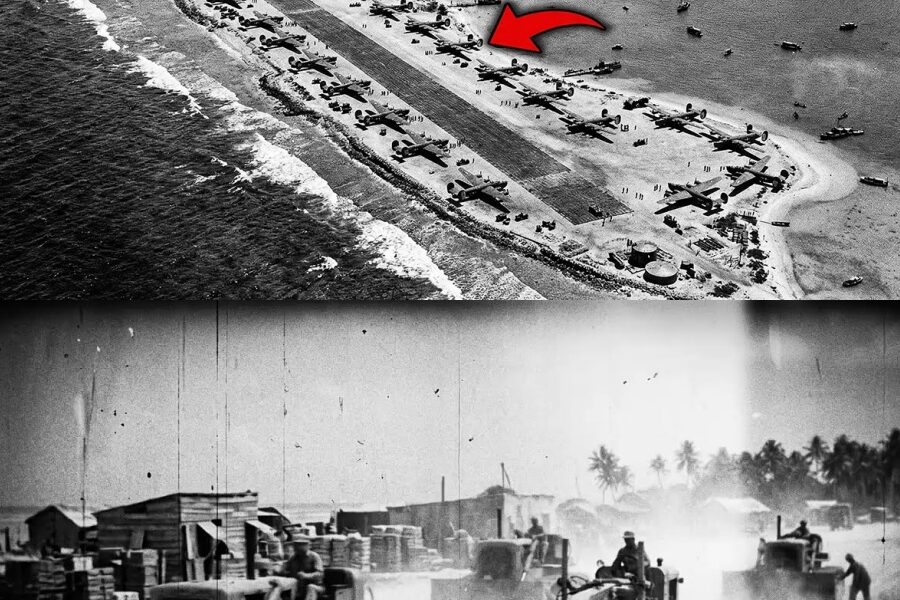
23 liberators of the 11th Bombardment Group lined up wing towing on a runway that American Navy Sebes had built from nothing, literally from the crushed remains of the coral island itself in barely 6 months. 6 months earlier, this island had been coconut palms and dense brush. There had been no runway, no fuel tanks, no radar installation, no pontoon peers, no base at all.
Just a sliver of coral in the middle of the largest ocean on Earth. 700 m southeast of the Japanese garrison on Terawa, 2600 m from Hawaii and 1100 m east of the Solomon Islands. A nothing place, a nowhere place until the US Navy Sebes decided to turn it into a weapon. The story of Fafuti atole is not about a famous battle.
No fleet engagement happened here. No legendary commander walked this beach. What happened here was quieter, more methodical, and in many ways, more decisive. A group of construction workers from naval construction battalions transformed one of nature’s most fragile land forms into a strategic spear pointed directly at Japan’s Pacific perimeter.
They built a fully operational air and naval base capable of launching these 60,000 lb heavy bombers on a strip of coral barely wider than a city block using the island itself as their primary building material. The military planners called it an advance base. The pilots who flew from it called it something less printable.
But the Japanese never called it anything because for 6 months they didn’t know it existed. This strategic blind spot, this incredible secret was a testament to American ingenuity and a critical turning point. If you’re enjoying this story, please support us with a like and subscribe for more untold stories. Now, back to that monumental oversight and its profound consequences.
That oversight would cost them dearly. October 2, 1942. Fonafoodi Lagoon dawn. 11 ships of the United States Navy entered the lagoon in the early morning light. It was a significant armada for such an insignificant looking place. Destroyers, transports, and support vessels, all materializing from the pre-dawn darkness to deliver the men and machinery that would transform this atole.
The operation had a code name, Fetlock. The mission was classified. The local islanders, most of whom spoke English learned from London Missionary Society teachers, watched from shore as the Americans began to come ashore. The landing force included the US Marine Corps fifth defense battalion. Their job was to protect whatever the Navy was about to build along with a detachment of the second naval construction battalion.
These were the CBS, the Navy’s builders. Their motto was we build, we fight. In the Pacific, the emphasis had been on the first half. The strategic logic behind Fafoodi was straightforward, even if the geography was not. Japan had swept through the central Pacific in late 1941 and early 1942 with terrifying speed. By December 1941, Tarow in the Gilbert Islands was in Japanese hands.
By mid 1942, their garrisons formed a defensive arc through the Gilberts and Marshals, protecting the inner ring of their Pacific Empire. American planners in Honolulu stared at the map and saw the problem clearly. To push northwest toward Japan’s home islands, they would need to crack through that ark. And to do that, they needed bases from which to project air power north deep into the Gilberts.
Funafoodi sat 700 m southeast of Tarow. In Pacific terms, that was close. Critically, its vast lagoon, roughly 13 mi long and 10 mi wide, could shelter an entire fleet. The lagoon offered anchorage for up to 100 ships, and the calm and closed water could support sea planes and PT boats that the open Pacific swell would otherwise make impossible to operate.
What the lagoon could not offer was solid ground. Fonafood’s land mass is not a single island, but a ring of tiny coral eyelets perched at top an ancient reef formation. The main eyelet fungafal is barely 400 m wide at its broadest point and far narrower along most of its length. It is composed entirely of calcium carbonate coral deposited over millennia by the polyps that built the reef beneath it.
This material has no deep roots into bedrock. There is no bedrock. Below the coral aggregate lies ocean. The entire land mass is in effect a thin crust resting at top the Pacific. The CBS looked at this and were not deterred. The second naval construction battalion’s detachment numbered a few hundred men equipped with bulldozers, road graders, coral crushers, and the kind of practical construction expertise that the Navy had gone to extraordinary lengths to assemble in a hurry since Pearl Harbor. They were not explorers.
They were builders with a blueprint and a deadline. And neither the landscape nor the geology was going to move the deadline. Within hours of the landing, bulldozers were ashore, and men were already felling coconut palms. The runway they needed had to run the full length of Fongafal, maximizing available distance before the coral shelf dropped away into the lagoon.
Trees came down by the thousands. A swampy bog near the island’s center had to be partially filled. The coral surface beneath was graded and compacted. Material quarried from the lagoon floor hauled ashore and crushed to specification. By November 1942, just 6 weeks after the landing, the first aircraft could use the new strip.
It was 5,000 ft long, barely adequate hardpacked coral crowned slightly in the middle for drainage. No taxiways, no revetments, no permanent lighting. It was the minimum viable runway built on minimum viable real estate in minimum viable time. The Americans were not alone in the work. Local islanders who had helped unload ships and clear brush during the initial days continued to assist.
Many spoke English. All knew the atal’s terrain intimately. Their cooperation and labor appeared repeatedly in unit logs with genuine appreciation. One account noted they had worked themselves to near exhaustion, helping the arriving forces unload gear from the landing vessels. By December 1942, a small hospital had been completed on the island.
PT boats arrived to run patrol missions in the lagoon. Four VA Kingfisher float planes arrived on December 15th to begin anti-ubmarine patrols over the surrounding ocean. Radar was installed. Plans for the aviation fuel farm were drawn up. The Japanese still didn’t know any of it existed. January through March 1943, Fafoodi at hole.
Through the early months of 1943, the base continued to grow in secrecy. The CBS worked under conditions that would have broken ordinary men. The equatorial sun heated tools so quickly that metal became untouchable by midm morning. In the afternoon, rain came without warning, flooding the runway apron before evaporating in minutes and leaving behind a humid, suffocating heat that was, if anything, worse than the direct sun.
Salt was everywhere, in the air, on the equipment, in the food. Supply ships arrived from Hawaii and Samoa carrying fuel, lumber, ammunition, and parts for equipment already damaged by the corrosive marine environment. At one point, a Japanese air raid alert sent a supply vessel fleeing the lagoon before it could be fully unloaded, leaving the seabbes without proper rations for weeks.
They survived on Vienna sausage and hardtac. The engineers had also discovered working with the coral material a fundamental truth about the island beneath their feet. Coral aggregate was not soil. It did not compact or drain the way that conventional runways required. Coral is primarily a skeletal material, porous, angular, prone to pulverizing under heavy loads into a fine silt that behaves like loose powder under compression.
Process it correctly with the proper gradation and moisture content. And the calcium carbonate acts as a natural binder, self-seementing under compaction. process it incorrectly or allow rain to leech the fine particles before they can cure and the surface stays loose, ruts under weight, and fails. The CB’s initial 5,000 ft strip had been constructed correctly enough for the lighter aircraft already using it.
But in April 1943, the second naval construction battalion received new orders. Extend the runway to 6600 ft. B-24 Liberator heavy bombers were coming. These aircraft loaded to nearly 60,000 lbs at maximum takeoff weight, powered by four Prattton Whitney R1830 engines producing 1,200 horsepower each, required not just more runway, but a surface that could withstand repeated punishment from main gear loads that would destroy an improperly prepared base.
The construction crews went back to work dredging fresh coral aggregate from the lagoon floor, crushing and grading it to specification, building the extension in layers. By April 1943, the strip reached 6600 ft, 2,000 m, with steel Marsden matte pierced steel planking laid over critical sections to distribute aircraft weight across a larger surface area and protect the coral base beneath from the concentrated loading of heavy aircraft.
Meanwhile, the strategic picture north of the equator was coming into sharper focus. American and Allied forces had ground down Japan’s offensive momentum through the brutal fighting in the Solomons at Guadal Tamal, at New Georgia, in the skies above both islands through 1942 and into 1943. The momentum was shifting slowly and at terrible cost.
Planners at Admiral Nimttz’s headquarters in Hawaii were now looking north toward the Gilberts with concrete intent. Tarawa had to fall. But to invade Tarawa, they needed weeks of sustained heavy bomber attack to degrade Japanese defenses. And to sustain that campaign, they needed a base within strike range.
Fafuti, well within striking range of Bashio Island, was the only answer the map offered. The CBS had been building toward this moment without fully knowing it. The whole Pacific War was converging on their runway. What the men building that runway could not see because no one outside of Nimitz’s operation staff could see it yet was the precise shape of what they were enabling.
The Gilbert Islands campaign that would use Fafuti as its air power foundation wasn’t formally approved until the summer of 1943. The CBS who extended the strip to 6,600 ft in April of that year were building to requirements handed down from above following orders that spoke of bomber requirements and fuel capacities but said nothing about Tarawa, nothing about the November invasion date that was already being calculated in planning rooms in Pearl Harbor and Washington.
They extended the runway, built the fuel farm, repaired the radar mast after the first Japanese raid, filled the bomb craters in the strip between operations, and kept building. The garrison on this speck of coral had grown to include Army Air Force’s personnel, Navy support staff, Marines running the anti-aircraft guns, and the CB construction crews, all packed onto an island whose widest point you could walk across in 5 minutes.
It was crowded, exposed, and in intermittent communication with the wider world via radio traffic that was monitored for brevity and operational security. The base held together because the men in it understood their function. Even when they didn’t know the plan, they were keeping the runway open. Whatever came next, the runway had to be open.
April 17th, 1943, Wheelerfield, Aahu, Hawaii. Major General Willis H. Hail assembled 23 B-24 Liberators and their crews for the mission briefing. The men heard their objective for the first time. They were flying to Fafuti. From there, they would mount the first American heavy bomber strikes against Japan’s positions in the Gilbert Islands.
When the pilots told their crews the destination, most had to look it up on a map. B24 Gunner Sergeant Ed Hess of the 11th Bombardment Group recalled the reaction. The island was halfway to Australia. The journey would take them 1,900 m to Canton Island where they would refuel, then 740 mi further to Fafuti, more than 2600 m from Hawaii in total. Not a mission, a migration.
They arrived on April 19th after hours of flying over featureless ocean. The aircraft came down onto the coral strip one by one, engines throttling back, wings rocking slightly in the unbroken crosswind that rolled across the atole with nothing to break it for a thousand miles.
Pilots who had trained on paved runways at Wheeler Field found themselves rolling out on a surface that transmitted a different character through the landing gear. The compacted coral communicating a faint vibration that was less engineered than geological, the island itself speaking through the wheels. What they found was austere beyond any base most of them had seen.
The enlisted crews shared canvas tents without floors or electricity, sleeping on cotss and shelters that offered no real protection from the equatorial heat. Officers had separate tents with electricity from gas- powered generators at least. Equipment for servicing the bombers was barely adequate. A pair of klet tracked vehicles for towing aircraft and dreadfully slow at hauling fuel trailers.
There was a messaul in name only. In reality, field kitchens set up on bare coral. None of this was a surprise. The CBS had built what the operational schedule demanded and what the island’s geometry allowed. A proper bomber base with hangers, hard stands, and maintenance depots requires flat, stable ground measured in acres. Fafood’s usable land measured in hundreds of meters of width.
You built what the island permitted, and you worked with what you had. They parked wing to-wing along the strip edge because there were no taxiways. There were few revetments. If Japanese bombers found them here, the aircraft would be sitting targets in a line. The briefing took place outdoors. The air crews sat on felled palm logs arranged like theater seats facing a map where Faudi sat bottom right and the target, Nau Island, 700 miles to the northwest, sat at top center.
Major General Hail stood before his men and explained the mission. The longest bombing strike yet launched from the central Pacific. Staging through a base that 6 months ago had been a coconut plantation. He had led the group here personally from Hawaii. On the night of April 21, 1943, 22 B24s rolled down the Fafoodi strip and climbed into the dark Pacific sky.
They flew northwest through the night and in the early hours of April 22 bombed Naou, Japan’s valuable phosphate producing island and a key logistics node for central Pacific operations. They returned to Fafoodi. The mission was a success. That same night, the Japanese found them. A Japanese air attack launched from Terawa struck the base in the pre-dawn darkness while the exhausted American crews slept.
The bombers parked wing to-wing made a dense, vulnerable target. One B-24 was destroyed. Five more were damaged. When the damage assessments came in at first light, Major General Hail counted usable aircraft for the scheduled Terawa strike. 12. Six planes had been taken out of the fight in a single night by an enemy who hadn’t known the base existed 24 hours earlier.
The attack revealed three truths simultaneously. First, Fafoodi worked. Its aircraft had struck Nau and returned undetected on the outbound leg. Second, the island’s exposed parking arrangements were a vulnerability that needed correction. And third, most significantly, the Japanese now knew where the base was, and they would be back.
Between March and November 1943, Japanese forces launched 10 separate air raids on Fafoodi from Nau and Terawa. American 90 millimeter anti-aircraft batteries on the island’s perimeter shot down six Japanese bombers during these attacks. The war had found and the base was going to have to survive it. It did. The surface struck repeatedly by blast fragments churned by aircraft operating through tropical downpours held.
The aggregate properly compacted and overlaid with steel mat absorbed punishment and was repaired quickly by the same construction crews who had built it. After [snorts] each raid, men were back with graders and compactors before the smoke cleared. By May 1943, Marine Fighting Squadron VMF441 arrived with F4F Wildcats to provide fighter cover. The base had teeth.
Now, one raid from the series carried particular consequence. On September 18th, 1943, American forces launched a coordinated strike using 24 B-24s staged through Fafuti against Tarawa. Japanese radar detected them on approach. Anti-aircraft fire shot down two bombers. The strike hit the air strip, fuel stores, and ammunition dumps.
Terawa had now been bombed twice from Fafuti, and the Japanese knew the base existed and roughly where it was. What they could not know was that their attacks on it were achieving almost nothing of lasting effect. Blast craters were filled, the surface regraded, the fuel form was protected, aircraft dispersed, and in November 1943, the base reached the full scale its builders had always been building toward.
The United States Army Air Force’s seventh bomber command established its headquarters at Fafuti. Two B-24 bombardment groups, the 11th Wing and the 30th Bombardment Group, arrived and began sustained operations against the Gilbert Islands. The target was Terawa. The date November 20th, 1943. Washington DC and the Pacific Theater, 1942.
To understand why Fafuti’s construction mattered beyond its single island on a single campaign, you have to understand the doctrine that drove it and why that doctrine represented a fundamental revolution in how wars could be waged. The prevailing assumption before Pearl Harbor was that America would fight the Pacific War the way European powers had fought their colonial campaigns from fixed established bases on large stable islands with proper harbor facilities developed infrastructure and room to build. Midway, Hawaii, the Philippines,
these were the assumed anchor points. The Japanese attack on Pearl Harbor and the fall of the Philippines destroyed that framework completely. What replaced it was the advanced base concept and it changed the nature of Pacific warfare more profoundly than any single weapon system deployed in the theater.
The advanced base doctrine held that American forces would project power not from fixed rear echelon positions, but from a chain of small, rapidly constructed forward installations, each leapfrogging the last, each pushing air power and naval reach closer to Japan. The enemy would be outbuilt as well as outfought.
The key was whether you could create a base faster than the enemy could respond to it. The problem was that this required builders who could operate under conditions that conventional civilian contractors were neither trained for nor willing to accept. In early 1942, the Navy created the naval construction battalions to fill exactly this role.
They drew from the construction trades, carpenters, iron workers, electricians, plumbers, heavy equipment operators, and civil engineers. They were older than the average fighting man, many in their 30s. And they brought to the Pacific something the Navy desperately needed. Hard one practical experience with realworld construction problems.
The CBS operated under a philosophy that was both simple and radical. No island is too small, no material too poor, no timeline too short. Every available resource, including the island itself, was a potential building material. At Fafuti, this philosophy encountered its most severe test because the only building material the island offered was the one thing nobody had engineered a major air base from before.
Coral aggregate had been used in minor road construction in Pacific territories before the war, but no one had tested it under the repeated concentrated loads of fully laden heavy bombers. The engineering understanding was limited and empirical. The critical insight that made Fafoodi possible was understanding which type of coral to use and how to process it correctly.
The second naval construction battalion’s engineers determined through careful practical work that coral aggregate functions as a runway base only if properly graded, screened to remove oversized chunks that create dangerous point loads under aircraft tires and processed to eliminate the finest silt fractions that stay permanently loose.
The middle gradations compacted with the right moisture content undergo a natural selfseementing reaction. The calcium carbonate particles bond under pressure creating a surface with loadbearing properties approaching compacted gravel or low-grade concrete. The enemy of this process was the weather FAFI guaranteed heavy tropical rainfall.
Rain that strikes freshly compacted coral before the cementing reaction completes. Doesn’t accelerate the process, it prevents it. The fine particles leech out before they can bond. The surface reverts to a shifting mass. The warfare history network’s account of the 11th bombardment group’s operations at Faudi moes this plainly.
The runway should have been as solid as concrete, but rain prevented the live coral used to build it from curing properly in early operations. This is where the advanced base philosophy proved its value at the molecular level. The CB solution was not to wait for dry weather. There was no dry season on the equator. The coral base was built in stages.
Each layer given time to cure before the next was added. Over critical sections, the landing threshold, the touchdown zone, steel Marsden mat pierced steel planking was laid directly over the coral. This interlocking grid distributed aircraft weight across a larger surface, protecting the base from point loading while the self-seementing reaction continued beneath.
The mat meant that even a runway whose base hadn’t fully cured could accept aircraft from day one. While the coral strengthened silently below the steel, the runway at Faudi was not built to be finished. It was built to be functional now and stronger later. This is the core engineering truth of the Pacific advanced base program and it was established here on this ATL by tradesmen who had never built an airfield from coral before and had no manual to consult.
The institutional knowledge that now exists about coral aggregate construction, its gradation requirements, its compaction parameters, its sensitivity to rain during the curing window was accumulated by men with bulldozers and graders on Fafuti and the other Ellis Islands atollo during a war under operational pressure that allowed no margin for extended experimentation.
The CBS who followed these first builders onto subsequent atollo arrived with better methods than their predecessors had because their predecessors had made the mistakes and documented what they learned. The institutional memory traveled with the battalions. November 1943 Bashio Island Terawa atal the target. The battle of Terawa would be remembered as one of the bloodiest 76 hours in Marine Corps history.
But before a single marine stepped into a landing craft, the battle was already being fought from Fafoodi strip. And the results of that campaign were more complicated than anyone wanted to admit. In the weeks before November 20th, 1943, B-24 crews based at Fafoodi flew repeated bombing missions against Bashio Island.
The 11th Wing and 30th Bombardment Group operating under 7th Bomber Command headquarters, now installed on the island, hit Bashio’s air strip, fuel dumps, gun positions, and communications infrastructure in a sustained air campaign designed to degrade the defenses the Marines were about to confront. The bombing did measurable damage.
Japanese aircraft on Bashio were struck and destroyed. Fuel stores were hit. And as Japanese accounts later confirmed, the sustained air pressure from Fafoodi and the newer Nanuha airfield completed in November 1943, approximately 200 m north of Fafoodi created weeks of cumulative pressure on the garrison. A Japanese intelligence assessment issued on November 8th, 1943 noted a significant increase in American bombing activity across the Gilberts and Marshalss.
The raids were noticed. They were doing work. But Bashio’s defenses had been engineered to absorb exactly this kind of punishment. Rear Admiral KG Shibazaki had overseen more than a year of fortification, pill boxes reinforced with coconut logs and concrete and coral fill, command shelters designed to survive direct hits from the air.
He told his men it would take a million Americans a 100red years to take Tarawa. The boast was not idle. It reflected the genuine depth of what those defenses presented. When the invasion fleet arrived on November 19th, the pre-invasion bombardment was staggering. Battleships, carrier aircraft, and the land-based bombers of seventh bomber command all striking simultaneously.
Estimates placed total ordinance dropped on Batio in the 24 hours before the Marines landed at approximately 6 million pounds. It was not enough. On November 20th, the Marines hit the beach. Lower tides than expected left landing craft stranded on the reef hundreds of yards from shore. Men abandoned their boats and waited.
Chest deep water. Direct fire from bunkers whose reinforced construction had absorbed 6 million pounds of explosives without fundamental damage. The first wave took 75% casualties. General Julian Smith’s message to his superior was spare and brutal. Issue in doubt. The 76 hours that followed were savage and close.
Each Japanese position had to be reduced individually. Grenades, satchel charges, flamethrowers at a cost measured in yards and minutes and lives. On the night of November 223, the remaining defenders launched a final charge. By morning, 17 Japanese soldiers survived from a garrison of approximately 4,500. The island was secured.
More than 1,000 Americans killed in action, more than 2,000 wounded, 76 hours on 290 acres. When the casualty figures reached the United States, the public reaction was shock and grief in roughly equal measure. The cost of atal warfare was now visible and unavoidable. The photographs that came back were unlike anything American newspapers had previously published from the Pacific.
Bodies in the water at the reef line, Marines lying where they fell on the beach, in rows, in the shallow approaches. The images forced a confrontation with what the war in the Pacific actually looked like at ground level. Not the clean geometry of naval charts, not the distant smudge of ships on a horizon, but this men dead on a beach two m long on an island almost no one had ever heard of.
The Navy convened boards of inquiry. The Marine Corps debriefed every surviving officer it could reach. War correspondents who had waited ashore with the assault waves filed dispatches that described what pre-invasion bombardment had and had not done. The answer was painful and specific. Sustained bombing from altitude against deeply reinforced fixed positions had limited effect.
The Japanese defenders on Batio had simply gone underground, waited out the explosions, and come back to their guns. But the strategic machine kept running. Even before Batio’s last defenders fell, CBS were moving onto the captured air strip and beginning repairs. The chain of advanced bases was extending itself in real time.
The same men, the same materials, the same methodology that had proven itself at Fafuti, now turning a destroyed Japanese installation into an Allied one. By December 18, a 4,000 ft fighter runway was ready on Batio. By the following weeks, a full 7,50 foot bomber strip was operational, paved with 10 in of compacted crushed coral mined from the same atole lagoon environment the CBS had first mastered 14 months earlier.
The lessons of Betio reshaped everything that followed. Pre-invasion bombardment was extended in duration and concentrated on specific defensive positions rather than area saturation. Amphibious tractor numbers were increased dramatically. Reconnaissance and tide table accuracy were made operational requirements. The marine survivors of Bettio were pulled from the line and given one assignment.
Trained the replacements in everything they had learned. Terowa became a terrible curriculum. The advanced base chain anchored at Faudi and now extending north through the Gilberts provided the logistical spine for what came next. The Marshall Islands campaign launched just 10 weeks after Teroa. The Philippine Sea campaign followed.
Even as the fighting front moved north and the island’s direct relevance diminished, Fafoodi remained a working node in the supply chain. Its vast lagoon accepting tankers, transferring fuel to fleet oilers, which carried it forward into the combat zone. Fauti atal and the Pacific Advanced Base Chain 1942 through 1944. Construction timeline.
October 2nd, 1942. Operation Fetlock. 11 ships. Fifth Marine Defense Battalion, Second Naval Construction Battalion Detachment Land on Fauti. November 1942, first runway complete. 5,000 ft, 1524 m of hardpacked coral aggregate. April 1943, extended to 6,600 ft. 2013 m Marsden Matt overlay on high stress sections.
Aviation fuel farm completed. November 1943, 7th Bomber Command HQ established. Two full B-24 bombardment groups operational for Operation Galvanic. Combat operations from Fafuti. April 21 through 22, 1943. First offensive strikes, Nauu and Tarowa bombed. Japanese retaliation raid the same night destroys one B24 damages five stripped repaired and operational the following morning September through November 1943 escalating campaign against Betio coordinated September 18th strike 24 B24s two lost to anti-aircraft fire followed by sustained pre-invasion
bombing under seventh bomber command for operation Galvanic enemy action Japanese discovery of base delayed until March 27th, 1943. 10 air raids followed through November 1943. American 90mm batteries destroyed six attacking aircraft across the entire series. Battle of Tarowa, Operation Galvanic, November 20th through 23rd, 1943.
American casualties, more than 1,000 killed, more than 2,000 wounded in 76 hours on 290 acres. Japanese garrison, approximately 4,500 defenders, 17 survived. Captured airirstrip rebuilt by CBS to 7,50 ft bomber runway within weeks. B24 Liberator, the aircraft that defined the mission. Dimensions: 110 ft wingspan, 68 foot length.
Four Pratt and Whitney R1830 engines at,200 horsepower each. Standard combat range 2,100 m. Total produced in World War II, 18,489 aircraft, more than any other American war plane. The pilot who looked down the Fafoodi strip on the night of April 21st, 1943, who felt the uncertainty of a surface that wasn’t quite what he’d been trained for.
He flew from something that had no business being what it was. He made it. 22 of them did. They bombed Naru, returned, and the surface held them. Then the Japanese struck that same night, put six planes out of action, and within 24 hours, 12 B-24s were taxiing out to bomb Tarawa from the same base that had just absorbed the attack.
The CBS repaired the craters and kept the strip open. The war moved on. Fafoodi never became famous. Its runway never made the news reels. The men who built it didn’t receive monuments, and their names weren’t in the communicates announcing the fall of Terawa. What they received was what builders usually receive.
The knowledge that the thing they made worked, that it held under weights it was never supposed to carry, and that men flew from it who would not otherwise have flown at all. The advanced base philosophy those CBS embodied would define the entire closing arc of the Pacific War. At Tinian in 1944, Navy construction battalions moved 11 million cubic yards of earth and coral to build six runways for the B29s that bombed Japan’s home islands.
At Ewoima, they repaired captured strips under sniper fire so that crippled superfortresses limping home from Tokyo could land rather than ditch in the open Pacific. The chain that started at Faudi in October 1942 extended link by link all the way to the moment the war ended. What this story ultimately reveals is something that does not appear cleanly in casualty counts or production statistics.
The Pacific War was won not just by fighting men, but by a parallel army of men who understood materials, who knew what coral aggregate would do under load, what rainfall would do to an unmatured base, what steel mat would do to a surface that wasn’t quite ready. These men were given terrain that didn’t suit their purposes and told to make it suit.
The tool they used was engineering, and the philosophy that guided it was relentlessly pragmatic. Build what you can build now. Protect it while it matures. Accept operations from day one and never stop improving. The runway at Fafoodi is still there. It became Fafoodi International Airport after the war and today it serves the small Pacific nation of Tuvalu, the Ellis Islands renamed upon independence.
Fiji Airways flies in twice a week. When no planes are scheduled, locals use the strip as a common area. Cricket matches, walking, daily life. A fire engine activates its siren when an aircraft approaches. The original coral aggregate subbase the second Naval Construction Battalion laid in 1942 lies beneath the modern surface.
Improved and resurfaced over the decades, but still at its foundation the same work. The ocean is still right there at the edges, exactly where it always was. The runway holds.